Range & Distribution
Breeding
Nonbreeding
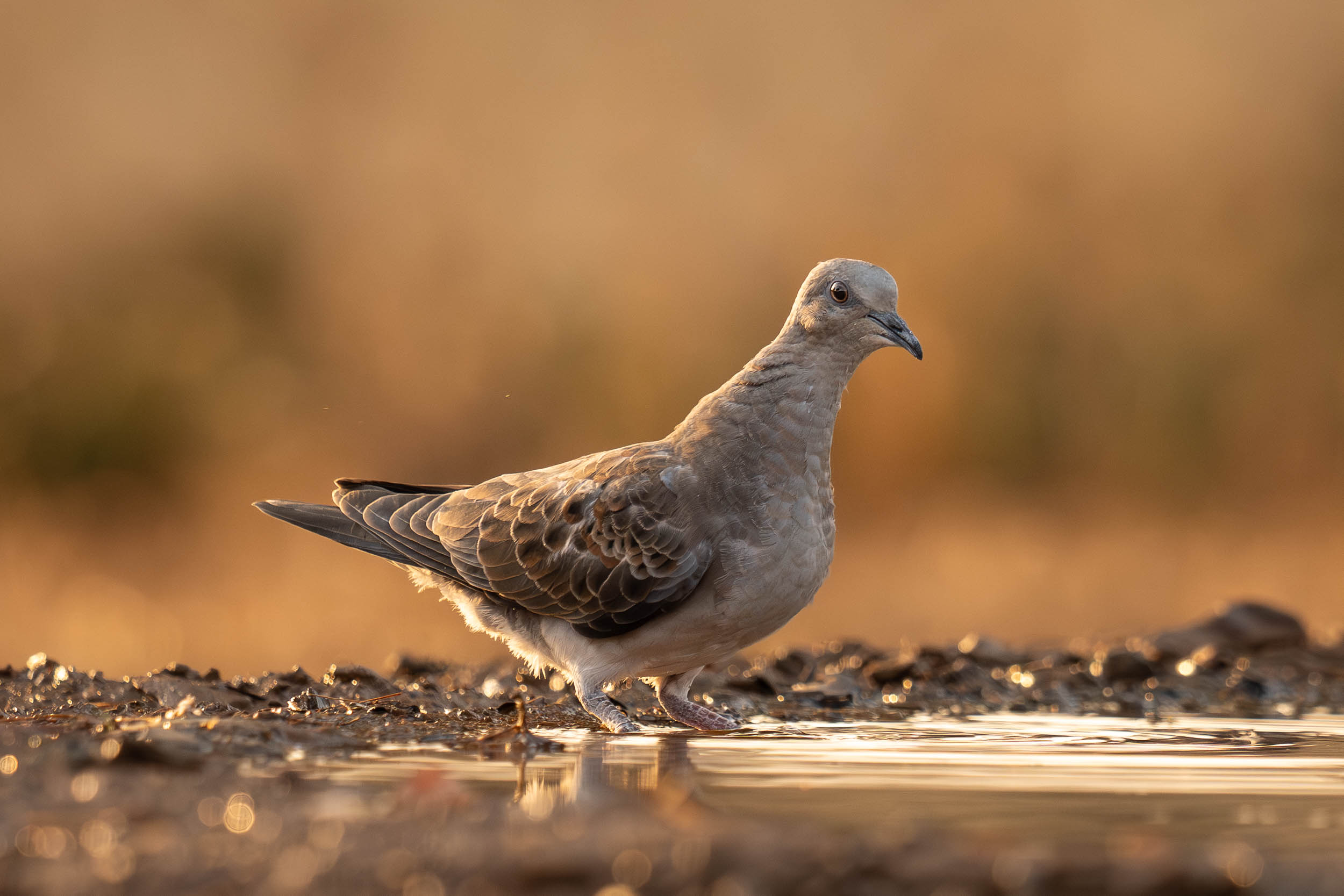
The European Turtle Dove is a small, slim, warm-toned dove, noticeably more delicate than the Collared Dove that often shares its range. Adults are diagnostic: the wing coverts are a tortoiseshell of black-centred feathers fringed in rich orange, and a patch of black-and-white bars marks each side of the neck. Juveniles — like the bird shown here — are duller and greyer, scaled rather than fiery on the wing, and lack the neck patch. The dark tail carries a thin white rim that shows as the bird drops to ground or water.
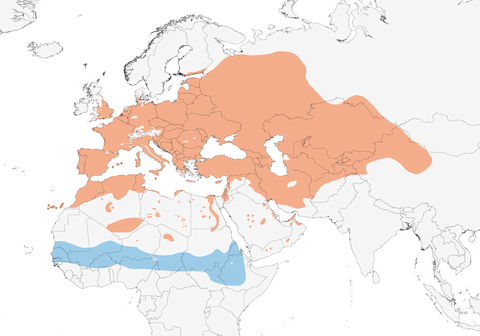
This is the only long-distance migrant among Europe’s doves, breeding across the continent and wintering in the Sahel zone south of the Sahara. It feeds quietly on the ground, taking the small seeds of arable weeds and grasses, and builds a characteristically flimsy platform of twigs in a hedge or thorny shrub for its two eggs. The song is a deep, purring “turr turr” — an old sound of warm farmland summers, and increasingly a scarce one.
Turtle Doves are shy and, across much of their range, genuinely scarce, so the reliable approach is to let them come to you: a hide at a Mediterranean drinking pool or feeding edge at first light, as in this image, will out-perform any stalk. Use a long lens and keep movement to a minimum. Given the species’ steep decline, weight your fieldcraft toward leaving birds undisturbed — a missed frame costs nothing, while a bird flushed from a scarce summer water source pays a real price.
The European Turtle Dove is listed as Vulnerable, uplisted in 2015 after steep, sustained declines across Europe driven mainly by agricultural intensification — which strips out the field-margin weeds it feeds on — alongside habitat loss and unsustainable hunting along its migration routes. There is cautious hope: a temporary hunting moratorium across the western flyway (France, Spain and Portugal) from 2021 was followed by roughly a 25% rebound in that population by 2024, evidence that hunting pressure had been a major driver and that flyway-scale management can work. Continued recovery depends on holding those gains while restoring seed-rich farmland.