Range & Distribution
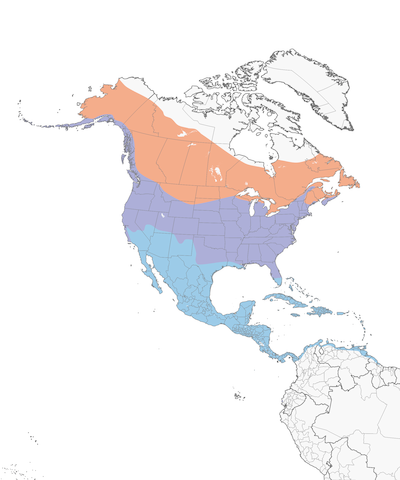
Year-round
Breeding
Nonbreeding
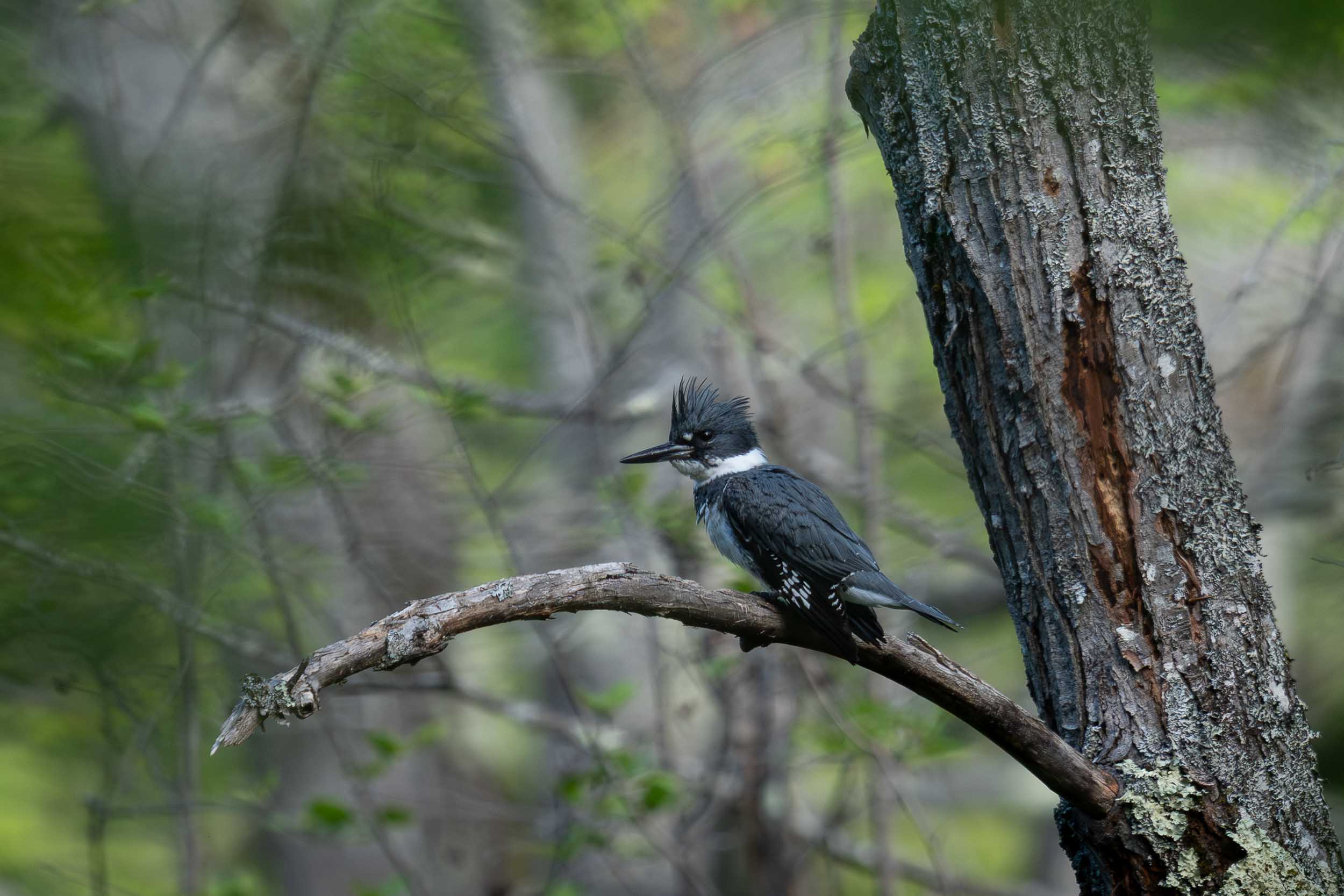
The Belted Kingfisher is the only kingfisher most of North America will ever see, and it is impossible to mistake for anything else — a stocky, top-heavy bird with an oversized head, a shaggy double-pointed crest, and a thick dagger of a bill, dressed in powder blue-grey with a clean white collar and underparts. It is also one of the few North American birds in which the female is the more colorful sex: she wears a chestnut band across the belly that the male lacks entirely, making any close view immediately sexable.
The loud, dry, mechanical rattle — given almost constantly in flight — announces this bird long before it is seen. Pairs and individuals patrol fixed territories along streams, rivers, lake shores, and tidal creeks, working a circuit of favored perches over open water. Hunting is by plunge dive, either straight from a perch or from a brief hover with the bill angled down, and a captured fish is carried back to the perch, beaten against it, and swallowed headfirst. Nesting is in a burrow excavated by both adults in a vertical earthen bank, typically one to two meters deep, usually close to or directly over water.
For photography this is a famously frustrating species — sharp-eyed, quick to flush, and inclined to rattle off downriver the moment it registers attention. Fieldcraft beats pursuit: learn the perch circuit on a stretch of water and wait concealed near one of them, ideally with the sun behind you and open water in front. A low kayak approach along a shoreline can work where a walking approach never will. In Maine, birds work beaver ponds, lake coves, and tidal creeks from ice-out into late fall, and a few linger through winter wherever water stays open.
The Belted Kingfisher remains widespread and secure, though long-term survey data show gradual declines across parts of the range. The species depends on two things human activity readily degrades: clear water — it hunts by sight, so siltation and pollution directly reduce feeding success — and vertical earthen banks for nest burrows, which bank stabilization and shoreline development eliminate. It has, conversely, benefited from human-made banks at gravel pits and road cuts. Nesting birds are sensitive to repeated disturbance at the burrow, and photographers should work known nest banks only from substantial distance or not at all.