
Range & Distribution
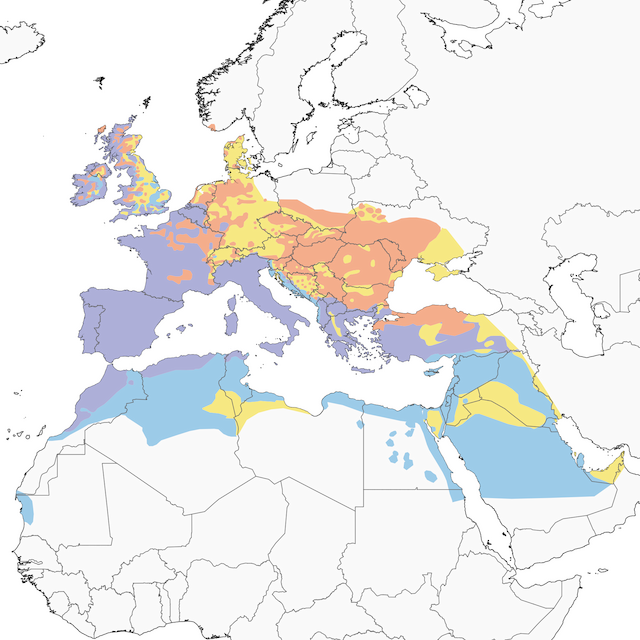
Breeding
Nonbreeding
The European Stonechat is a compact, alert little bird with an upright posture and a habit of perching prominently on exposed bush tops, fence posts, and bracken stems — holding position briefly before dropping to catch prey on the ground and returning to the same perch. The male in breeding plumage is boldly marked with a black head, white half-collar, orange-rufous breast, and white wing patches.
The common name references the call — a sharp, hard tack-tack sound likened to two pebbles struck together, delivered persistently when the bird is alarmed or agitated at an intruder near the nest. The call is often heard before the bird is seen, in low heathland and coastal scrub where its cryptic habits can make visual location difficult.
Open heathland and coastal scrub with scattered gorse, bracken, and bare ground represent ideal habitat to find this species. The bird's tendency to use prominent exposed perches — the tip of a gorse bush, a wire fence, a tall bracken frond — makes it one of the more cooperative small passerine subjects for photography, as the perching behavior is repetitive and predictable.
The European Stonechat is common across its range with no significant conservation concerns at the global level. Habitat loss — particularly the decline of heathland and coastal scrub through agricultural conversion and development — has caused regional declines in some areas of western Europe. The species is sensitive to prolonged cold winters that reduce invertebrate prey availability.