Range & Distribution
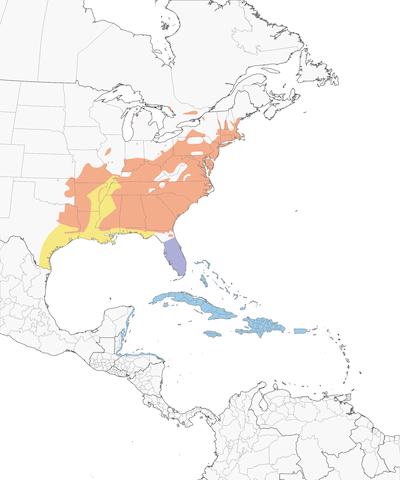
Year-round
Breeding
Migration
Nonbreeding
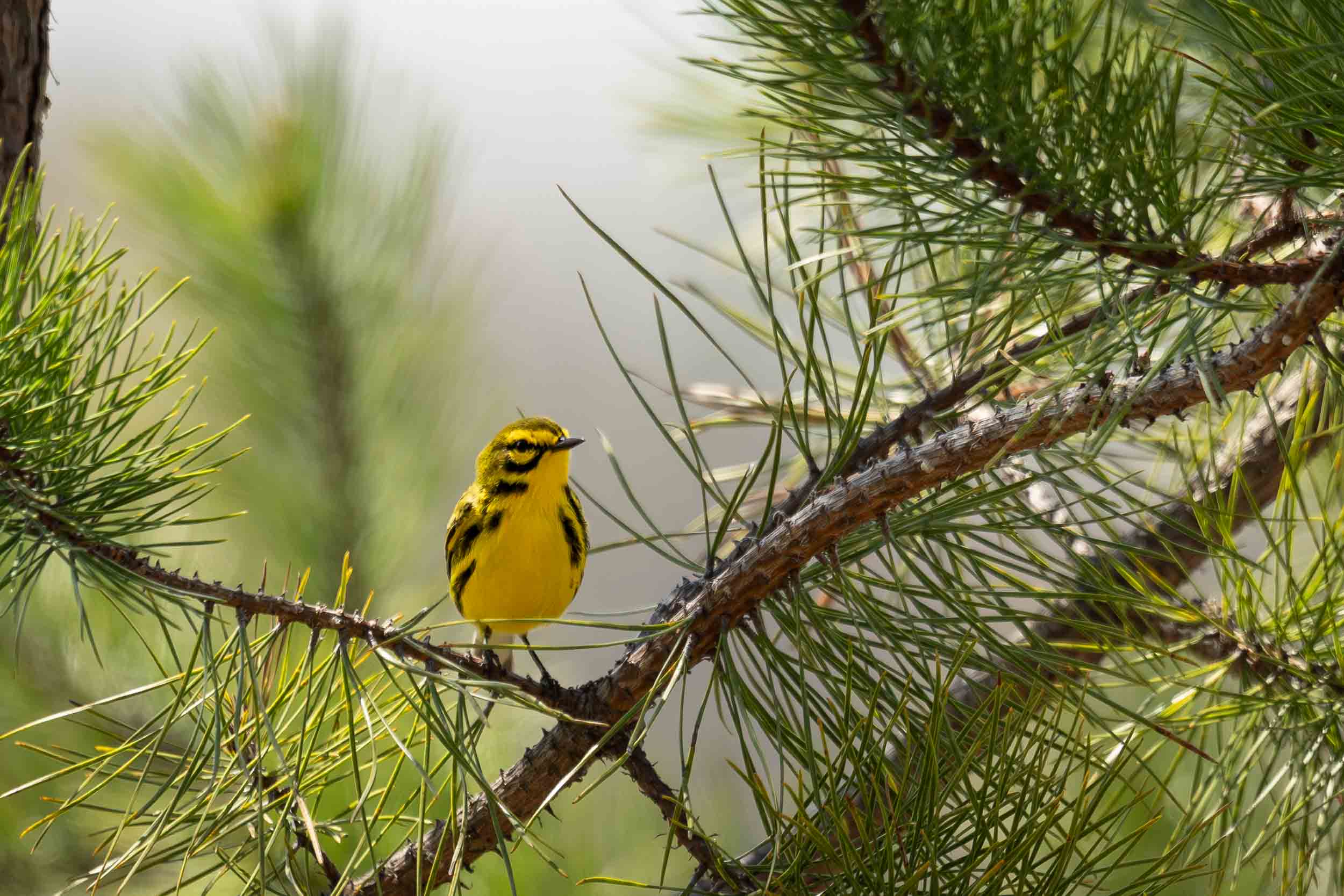
The Prairie Warbler is a small, yellow-bodied warbler misnamed for its habitat — it is a bird of scrubby clearings and young woodland, not prairie. Males are bright yellow below with bold black streaks down the sides, olive-green above with chestnut streaks on the back, and a yellow face marked by a black line through the eye and a black crescent beneath it. Like the Palm Warbler it bobs its tail, a useful clue when the bird is buried in cover.
It forages low and deliberately in shrubs and saplings, gleaning caterpillars, beetles and spiders from twigs and the undersides of leaves, sometimes hovering to reach them. The nest is an open cup placed low in a shrub or sapling, where the female lays three to five eggs, and the male's song is a thin, rising series of buzzy notes that climbs the scale. It is a long-distance migrant, wintering in Florida, the Caribbean and coastal Central America.
Southern Maine is near the northern edge of the Prairie Warbler's range, where it is a local and uncommon breeder in dry barrens, power-line cuts and regenerating clearings rather than mature forest. Those open, scrubby settings are the photographer's advantage — the bird works at eye level and pauses on exposed twigs. Track the buzzy song to a singing male and wait for it to climb to a bare perch; the side streaks and face pattern reward a clean background.
The Prairie Warbler is listed as Least Concern, but its population has declined over recent decades as the early-successional scrub it depends on matures into forest or is developed. It is an edge-and-clearing specialist in a landscape that increasingly lacks young, brushy stages, and its conservation is tied to disturbance — fire, cutting and old-field succession — that keeps habitat open. Where managed barrens and utility corridors are maintained, it persists well.