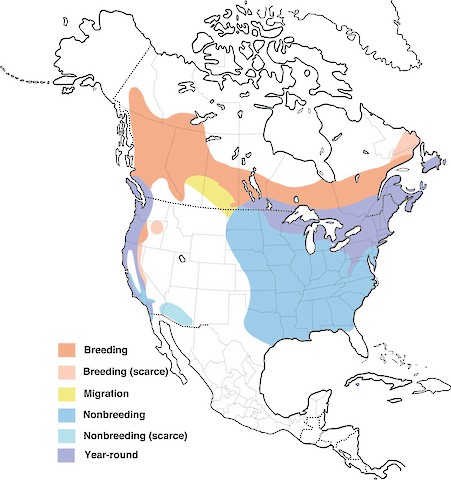
Range & Distribution
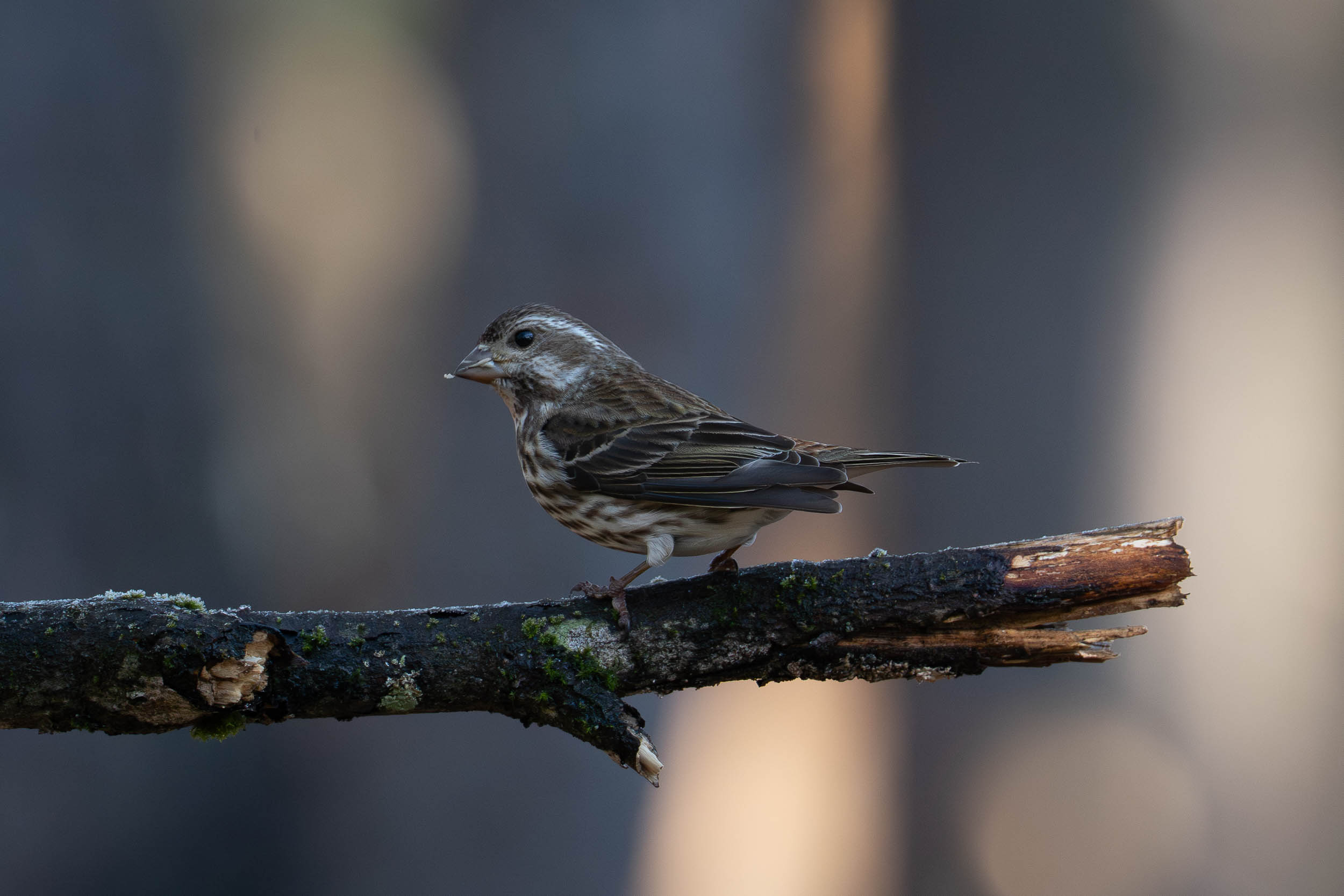
The Purple Finch is a stocky, large-billed finch in which the male is washed a deep raspberry-red over the head, breast and back — not purple — while the female and immature are crisply brown-streaked with a strong face pattern: a pale eyebrow and a dark jaw stripe framing a brown cheek. That bold female face and the clean, heavily streaked underparts are the surest way to separate it from the similar House Finch.
It feeds on seeds, buds and berries, with some insects in summer, and moves through coniferous and mixed woodland in loose flocks, readily coming to seed feeders in winter. The nest is a neat cup saddled on a horizontal conifer branch, where the female lays four to six eggs. Numbers in any given winter are irruptive, swelling southward in years when the northern seed crop fails.
The Purple Finch is the state bird of Maine and a genuine resident of the state's conifer and mixed forests rather than just a winter visitor. At feeders it gives a reliable chance at both plumages side by side — work for the moment a raspberry male sits clean of clutter, and use the strongly marked female to practise separating it from House Finch. Overcast light keeps the red from burning out and holds the streaking sharp.
The Purple Finch is listed as Least Concern, though its numbers have declined across parts of its range, partly through competition at feeders and in habitat with the expanding House Finch. It depends on healthy coniferous and mixed forest for breeding, and its irruptive winter movements make local counts swing widely from year to year. As Maine's state bird it is both an easy feeder subject and a reminder of how much the northern forest shapes the region's birdlife.